

Anubis and Shadow Work: Meeting Endings With Dignity
By Phoenix Fire Oracle · October 31, 2026

Some thresholds ask you to stop pretending that nothing has changed. They ask for care, not panic. Attention, not punishment.
Anubis brings a different atmosphere to the work of endings: deliberate, watchful, and concerned with passage. To approach him is to consider how something can be allowed to end without treating what it held as worthless.
Who Is Anubis?
Anubis is an ancient Egyptian god associated with embalming, the protection of the dead, and their passage through funerary rites. He is commonly represented as a black jackal or canine, or with a human body and a jackal’s head.
The Western Australian Museum’s curatorial account describes his involvement in mummification, protection, and the judgement scene in which he attends the scales weighing the heart against the emblem of Ma’at. His task is not interchangeable with that of every other Egyptian funerary deity. Jackal-headed imagery alone does not identify every figure as Anubis.
The same museum account describes traditions in which he assists Osiris and supports the deceased in ceremonies associated with renewed capacities to breathe, speak, and see. These are historically situated funerary beliefs; the reflective exercise below is a contemporary adaptation, not a burial rite.
How Anubis Supports Shadow Work
For a contemporary devotee, Anubis can be approached with reverence while reflection turns toward endings, responsibility, and what deserves protection during a change. This does not mean that an ending you fear has been predicted or spiritually ordered.
An ending may be the loss of a familiar role, the retirement of an unrealistic expectation, or a decision to stop repeating a conversation that cannot produce a new answer. Begin by naming exactly what is ending. Precision can keep a difficult change from becoming a judgement on your entire life.
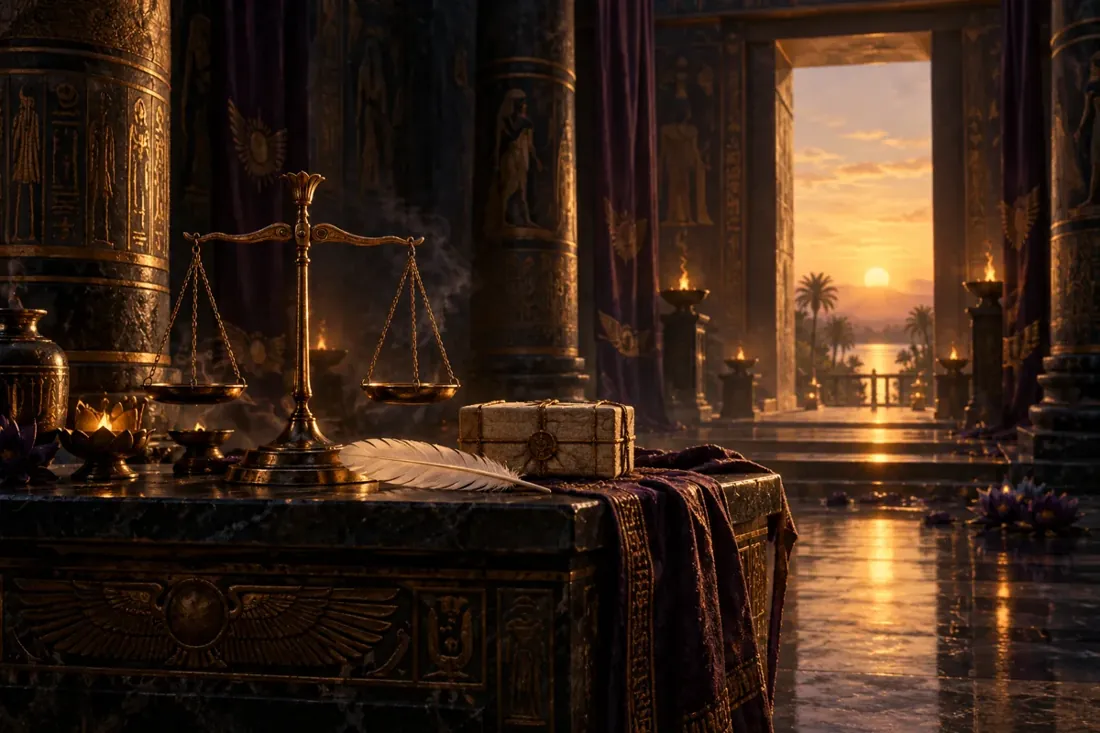
The image of weighing can invite honest assessment without becoming a courtroom for self-hatred. What happened? What belongs to you to acknowledge? What belongs to someone else? What repair is possible, and what cannot be undone? A truthful answer leaves room for dignity as well as accountability.
When You Feel Drawn to Anubis
You may be drawn to study him while grieving, making a difficult decision, or seeking a steadier way to face change. Learn his historical imagery and roles before building a personal practice around them.
Notice whether devotion helps you become more careful and present. A dream, symbol, or moment of recognition can have personal meaning without being treated as a forecast of death or danger. The practice can meet uncertainty without turning uncertainty into an omen.
Honoring Anubis Through Care
A suggested contemporary offering might be clean water, a brief prayer, or the careful tending of a remembrance space. Keeping a promise, handling someone’s memory respectfully, or completing neglected practical care can also give your devotion an ordinary form.
Choose what fits your beliefs and circumstances. You do not need funerary objects, costly materials, or a frightening experience. When grief is heavy, welcome human support alongside spiritual practice rather than asking ritual to carry everything alone.
A Practice of Honest Weighing
Set an ordinary object beside a blank page. Let it mark the intention to look carefully rather than harshly.
- Write the ending or change in one specific sentence. Separate the event from predictions about everything it might mean.
- List what you can responsibly own, what is outside your control, and what still needs information.
- Name one thing worth preserving: a value, a memory, a skill, a relationship, or a practical resource.
- Choose a closing act that is safe and ordinary: finish a task, write an unsent letter, organize a keepsake, or make a needed appointment.
Shadow Work Prompt: What Can End Without Condemnation?
What are you keeping alive because letting it end feels like admitting that you failed? What could acknowledging the truth allow you to care for more honestly?
Keep the answer proportionate. One promise that needs renegotiation does not mean you are incapable of commitment. One mistake can require repair without becoming the whole story of who you are.
An Original Invocation
“Anubis, may I meet this threshold with a clear mind and careful hands. May I protect what deserves keeping, acknowledge what is mine to repair, and release what cannot be carried forward.”
Closing Reflection
Dignity does not require an ending to feel easy. It asks that you remain present enough to choose the next act of care. Sometimes that act is the beginning of a different relationship with what has been.
Sources and further reading
The historical material above draws on these sources. The journaling practices and invocations are contemporary Phoenix Fire Oracle devotional reflections, rather than reconstructed ancient rites.
- Western Australian Museum: Anubis, curatorial introduction
- Australian Museum: Religion and gods in ancient Egypt